
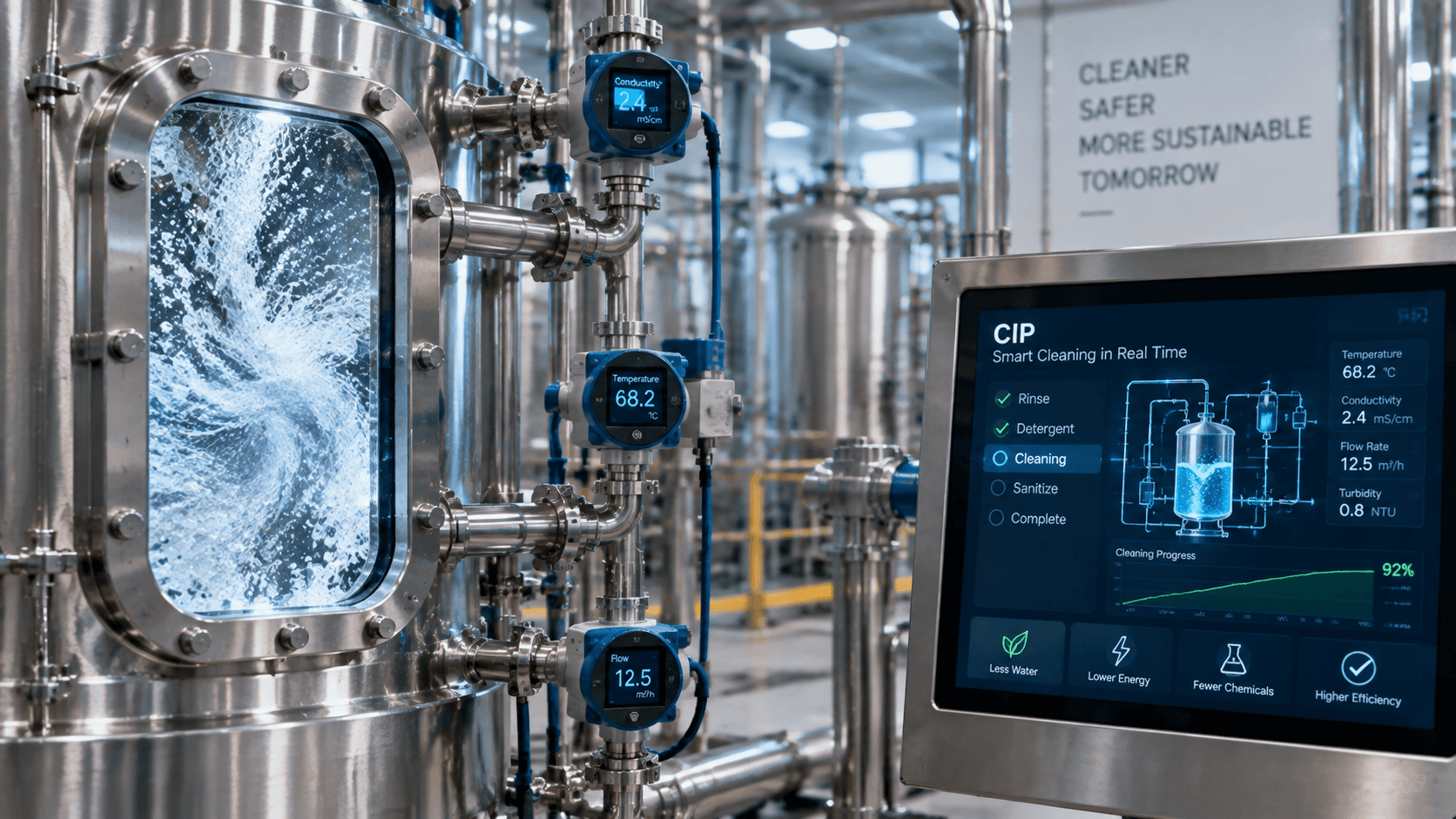

Clean-in-Place (CIP) systems clean the inside of process equipment without requiring it to be dismantled. They are widely used in food, beverage, dairy and pharmaceutical production, where cleaning performance and hygiene are essential.
A CIP cycle typically uses a combination of flow, cleaning chemicals, temperature and time. The exact process varies by equipment, product and hygiene requirements. But when a cycle relies mainly on preset parameters, operators may have limited visibility into what is happening inside the line during a wash.
That is changing. Monitoring tools can collect data from CIP cycles and help teams identify abnormal conditions, verify whether a wash followed its required parameters and find opportunities to improve performance. Research is also exploring whether sensors can detect cleaning progress more directly.
From preset cycles to data-informed cleaning
Preset cleaning cycles remain important: food and beverage producers need repeatable processes that meet their hygiene and quality requirements. The opportunity is to use data to understand how those cycles perform and where adjustments may be appropriate.
That can help operators investigate issues such as missed wash conditions, unusually long cycles or differences between production lines. Any changes to a cleaning process still need to be assessed against the facility’s food-safety and validation requirements.
Commercial example: Ecolab CIP IQ
Ecolab describes its CIP IQ platform as an AI-enhanced solution that tracks CIP performance, collects data centrally and provides recommendations. Its listed features include wash-conformance scores, alerts for abnormal or missed wash events, and AI-assisted analysis to help identify anomalies and troubleshoot.
Ecolab also describes a Precise Wash module that uses real-time soil data to help fine-tune wash settings by line and cycle. In a 2025 announcement, the company said its partnership with 4T2 Sensors could support dynamically optimizing wash duration based on the fluid detected in the system. That capability should be understood in the context of the specific technology and implementation; it does not mean every CIP system automatically adjusts its cycle in real time.
Ecolab has reported efficiency and water-use results from customer sites. The company says its reported averages depended on customers implementing its recommendations, and that results vary by operation. These figures are company-reported examples, not guaranteed outcomes for other plants.
Sources: Ecolab CIP IQ product information and Ecolab’s CIP IQ launch announcement.
What the research is exploring
Some emerging work focuses on measuring soil remaining on equipment surfaces rather than relying only on measurements of the cleaning fluid.
In a 2020 study, researchers tested optical and ultrasonic sensors on a benchtop rig using three food materials. They combined sensor measurements with machine learning to estimate the amount of residue remaining during cleaning. The results showed potential for monitoring cleaning progress under the study’s test conditions. They do not, on their own, establish that the method is ready for routine use across industrial production lines.
Other research has examined how pipe geometry affects cleaning flow. A numerical investigation of a four-lobed swirl pipe found that it could increase wall shear stress downstream. This offers a possible way to influence cleaning performance, but a simulation result should not be presented as proof of reduced cycle times in operating plants.
Sources: the sensor and machine-learning study and the swirl-pipe investigation.
What this could mean for food and dairy producers
Data-informed CIP can help manufacturers investigate cleaning performance, identify process variation and assess where water, energy, chemicals or production time may be used inefficiently. The right approach depends on the equipment, the product being processed, the soils involved and the facility’s hygiene requirements.
For decision-makers, the practical questions are:
- What data does the current CIP system collect?
- Can the team see whether each cycle met its required conditions?
- Which adjustments are permitted under the facility’s validation and food-safety procedures?
- Are reported improvements supported by results from comparable lines and operating conditions?
Answering these questions can help teams evaluate whether monitoring, sensor upgrades or process changes are worth exploring.
About the report
The STIMAnalytics Clean-in-Place in Dairy Industry Patent Landscape Report examines patent activity, technology areas, applicants and innovation trends related to clean-in-place systems.
Explore the full report to learn more about the technologies and organizations shaping CIP development in the dairy industry.