

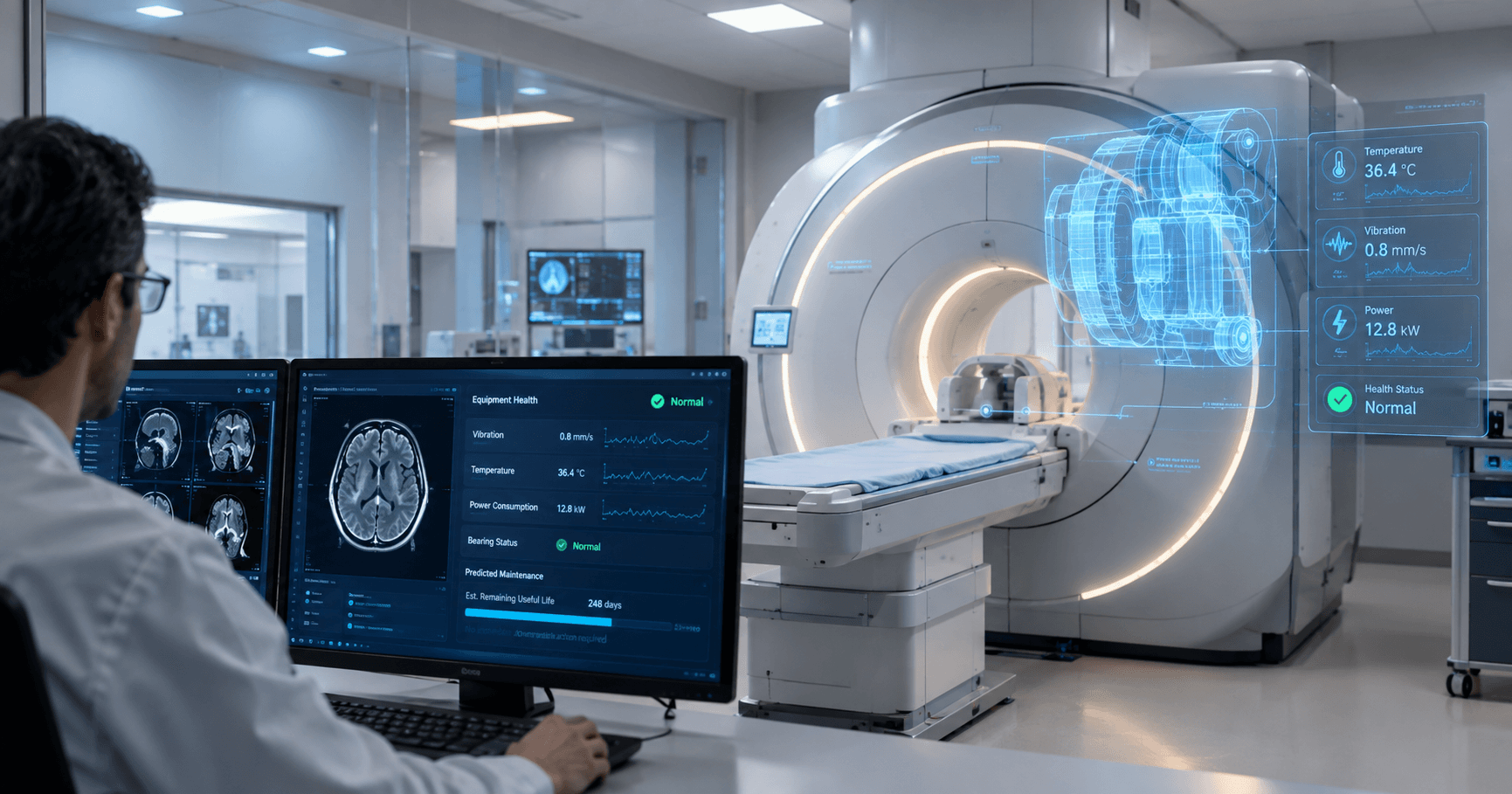

Predictive maintenance in healthcare is changing how hospitals manage critical medical equipment. An MRI scanner does not fail all at once — long before it stops working, it begins leaving measurable signals. A bearing may run slightly hotter than expected, vibration patterns may gradually shift, or a cooling system may consume more power than it did months earlier.
A technician performing routine checks will not detect most of these early warning signs. A connected monitoring system that continuously analyzes equipment performance can.
That gap is where the next generation of healthcare technology is developing: using artificial intelligence, sensors, and advanced analytics to predict medical equipment failures before they disrupt patient care.
The companies leading this transition include Siemens Healthineers, GE HealthCare, and Philips — three major players in medical imaging and healthcare equipment.
Why Predictive Maintenance in Healthcare Is Becoming Strategic
A single day of MRI downtime can create significant operational challenges for hospitals, including lost capacity, delayed appointments, and disruptions across radiology workflows.
As healthcare systems operate increasingly complex imaging fleets, the ability to predict failures before they happen is becoming more important.
Predictive maintenance helps hospitals:
- Reduce unexpected equipment downtime
- Improve availability of critical imaging systems
- Schedule repairs before failures occur
- Optimize maintenance resources
- Improve operational continuity for clinical teams
The shift is moving healthcare equipment maintenance from reactive repair toward proactive, data-driven management.
Three Different Approaches to Medical Equipment Monitoring
GE HealthCare: Digital Twins and Predictive Analytics
GE HealthCare has developed predictive maintenance capabilities that use digital twin approaches to monitor medical equipment performance.
By creating a virtual representation of physical systems, digital twin technology can help analyze equipment behavior, identify early signs of degradation, and support planned maintenance before failures interrupt clinical operations.
This approach allows hospitals to replace components during scheduled maintenance windows rather than responding after equipment failure occurs.
Siemens Healthineers: Remote Monitoring and Proactive Services
Siemens Healthineers has focused on integrating AI-driven monitoring with remote service capabilities.
Its Smart Remote Services (SRS) platform enables continuous communication between medical equipment and service teams, allowing faster identification of issues and remote diagnostics without requiring immediate on-site intervention.
Programs such as the Guardian Program on laboratory systems demonstrate how AI and proactive service models can help identify maintenance needs before they become operational problems.
Philips: Predictive Service Across Imaging Systems
Philips has expanded predictive maintenance across its healthcare equipment ecosystem through remote monitoring and proactive service approaches.
The company has reported increasing use of predictive methods across areas including medical imaging, image-guided therapy, and other healthcare equipment services.
Together, these approaches represent different strategies for the same objective: identifying equipment problems before they affect patients and clinical operations.
Why Healthcare Cannot Simply Copy Industrial Predictive Maintenance
Predictive maintenance has already been widely adopted in manufacturing, where sensors and machine learning models are used to monitor industrial equipment.
However, healthcare introduces additional complexity.
When a manufacturing machine fails, production may slow down. When a medical imaging system fails, patient diagnosis and treatment workflows may be affected.
This difference changes how predictive maintenance technology is designed and evaluated.
Healthcare equipment monitoring must consider:
- Patient safety requirements
- Regulatory compliance
- Equipment reliability
- Clinical workflow impact
- Data security
The underlying technologies may be similar — sensors, machine learning models, and condition monitoring — but the consequences of failure are significantly different.
The Technology Behind Healthcare Predictive Maintenance
The next generation of medical equipment monitoring combines several technologies:
Sensor-Based Condition Monitoring
Sensors continuously collect information such as:
- Temperature changes
- Vibration patterns
- Power consumption
- Component performance indicators
This data creates a real-time picture of equipment health.
Artificial Intelligence and Predictive Analytics
AI models analyze equipment behavior over time to identify patterns associated with future failures.
Instead of asking:
“Has the machine failed?”
predictive maintenance asks:
“Is this machine showing signs that failure is becoming more likely?”
Digital Twins and Remote Diagnostics
Digital twins allow healthcare organizations to model equipment behavior, while remote diagnostic systems enable service teams to identify issues faster.
Together, these technologies support more efficient maintenance strategies.
Key Innovators in Healthcare Predictive Maintenance
The healthcare predictive maintenance ecosystem includes:
Medical Equipment Providers
- Siemens Healthineers
- GE HealthCare
- Philips
These companies are integrating AI, connectivity, and analytics into imaging and diagnostic systems.
Technology Enablers
- AI software providers
- Sensor technology companies
- Cloud infrastructure providers
- Industrial analytics platforms
These technologies support the development of smarter healthcare equipment monitoring systems.
Patent activity across these organizations highlights increasing innovation around:
- AI-based equipment failure prediction
- Remote diagnostics
- Sensor fusion
- Medical device analytics
- Digital twin applications
Where Predictive Maintenance in Healthcare Is Heading
Predictive maintenance is moving healthcare equipment management from reactive repair toward continuous intelligence.
As AI, sensors, remote connectivity, and digital twins continue to advance, hospitals will increasingly be able to anticipate equipment issues before they interrupt clinical operations.
The future of healthcare technology is not only about creating more advanced machines — it is also about ensuring those machines remain available, reliable, and optimized throughout their operational life.
Explore the STIMAnalytics Condition Monitoring Technology Report to discover emerging technologies, key innovators, patent activity, and global innovation trends shaping the future of predictive maintenance in healthcare.