


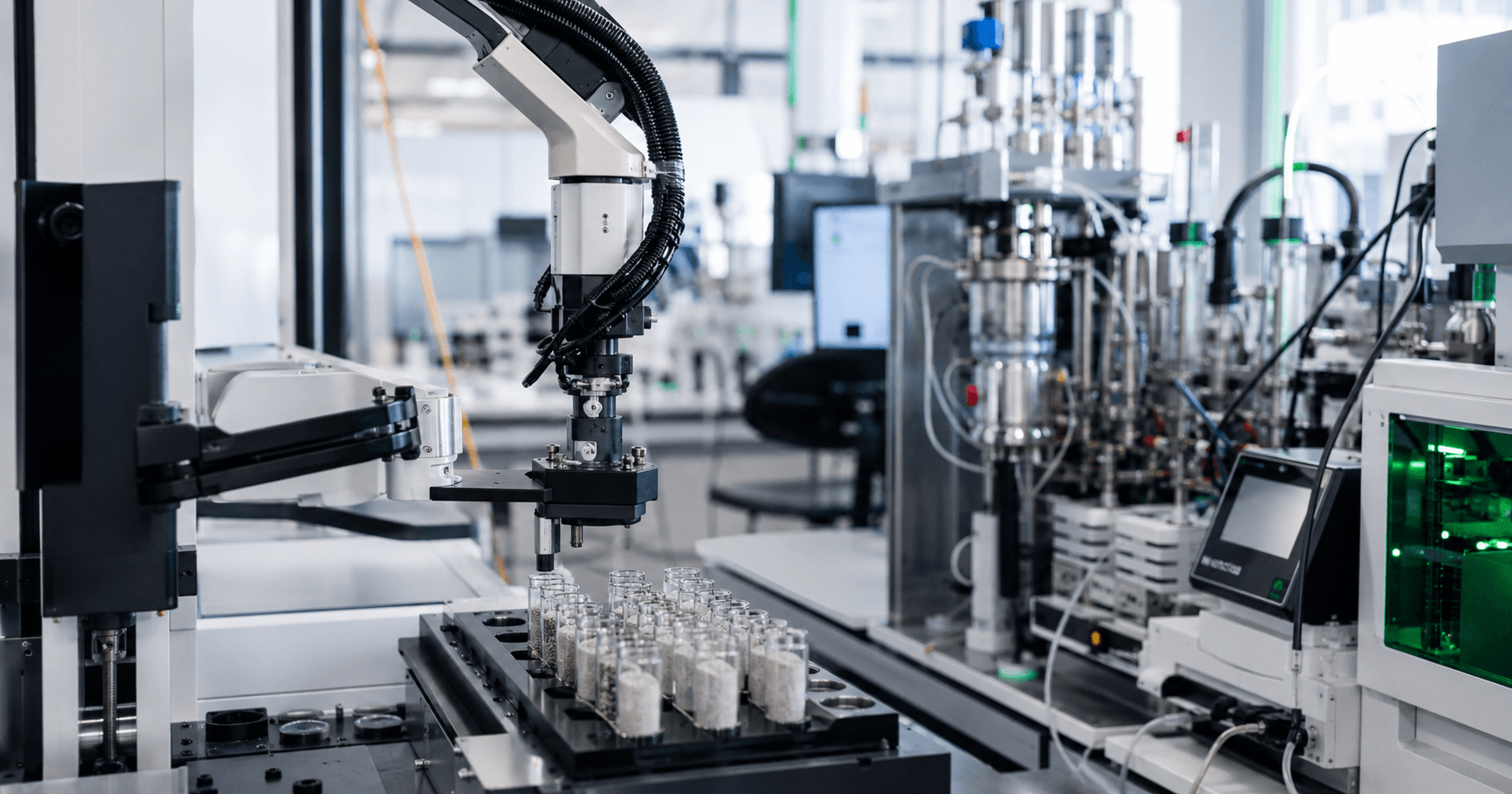

Industrial innovation is entering a new phase as artificial intelligence moves beyond analytics and into the physical process of scientific discovery. The U.S. Department of Energy’s Advanced Research Projects Agency-Energy (ARPA-E) has announced $34 million in funding for 12 projects that combine artificial intelligence with autonomous laboratories to accelerate catalyst development for fuels and chemical production.
The initiative highlights a broader technology shift: using AI, automation, and high-throughput experimentation to shorten development cycles for critical industrial materials. Technology intelligence shows that companies and research organizations are increasingly investing in AI-enabled discovery systems that can design, test, and optimize new materials faster than traditional approaches.
Industrial Innovation Moves Toward AI-Driven Discovery
Catalysts play a critical role across energy and chemical industries, enabling processes that convert raw materials into fuels, chemicals, and industrial products.
Traditionally, developing new catalysts requires years of computational analysis, laboratory experiments, and validation. The complexity comes from the enormous number of possible material combinations, operating conditions, and performance requirements that researchers must evaluate.
The DOE’s CATALCHEM-E program aims to transform this process by combining:
- Machine learning models
- AI-guided material design
- Automated laboratory systems
- High-throughput experimentation
- Advanced computational simulation
The objective is to reduce catalyst development timelines from approximately a decade to around one year, creating faster pathways from scientific discovery to industrial application.
Why AI-Enabled Material Discovery Is Becoming Strategic
The acceleration of catalyst development reflects several important industrial challenges:
- Increasing demand for more efficient chemical processes
- Need for lower-energy industrial production
- Pressure to develop advanced materials faster
- Growing complexity of industrial chemistry challenges
- Demand for stronger domestic technology capabilities
Industries such as refining, chemicals, hydrogen production, and advanced manufacturing depend heavily on improved catalyst technologies.
As industrial systems become more complex, innovation is moving from traditional experimental approaches toward data-driven discovery methods that can explore larger technology spaces more efficiently.
Patent Intelligence Reveals Where Industrial AI Innovation Is Moving
Technology intelligence provides visibility into how companies, universities, and research organizations are developing next-generation industrial capabilities.
O STIMAnalytics Patent Landscape Reports analyze global innovation activity to identify emerging technologies, leading innovators, technology clusters, and future development directions.
Patent intelligence helps organizations understand:
- Where AI is being applied in industrial processes
- Which organizations are developing new discovery methods
- How automation is transforming research workflows
- Which technology areas are gaining momentum
The combination of AI and autonomous experimentation represents a growing innovation area where artificial intelligence is becoming integrated directly into engineering and laboratory processes.
Three Innovation Areas Shaping AI-Driven Industrial Development
1. AI-Guided Material and Catalyst Design
Researchers are increasingly using AI models to predict promising materials and optimize chemical performance.
These approaches can help accelerate the discovery of:
- New catalyst compositions
- Alternative material structures
- Higher-performance industrial solutions
- More efficient chemical processes
Instead of testing thousands of possibilities manually, AI systems can prioritize the most promising candidates.
2. Autonomous Laboratories and Automated Experimentation
A major innovation direction is the development of self-driving laboratories that combine robotics, AI models, and automated testing systems.
These platforms enable continuous cycles of:
Prediction → Synthesis → Testing → Learning → Optimization
This approach allows researchers to evaluate possibilities much faster while reducing manual experimentation requirements.
3. Industrial Scale-Up and Commercial Deployment
Moving laboratory discoveries into real industrial applications remains a critical challenge.
The DOE-funded projects focus not only on discovering new catalysts but also on validating their performance through industrially relevant testing environments.
This connection between AI discovery and practical deployment is essential for creating technologies that can impact energy and chemical industries.
Key Innovators and Industry Activity
AI-driven catalyst development is bringing together a diverse innovation ecosystem involving government research agencies, universities, national laboratories, and industrial technology developers.
Selected projects within the CATALCHEM-E program include research efforts from organizations such as:
- University of Wisconsin–Madison
- Ames National Laboratory
- North Carolina State University
These projects demonstrate how AI, automation, and advanced experimentation are becoming increasingly connected across the industrial research landscape.
Beyond individual projects, the broader technology ecosystem includes companies and research organizations developing AI platforms, laboratory automation technologies, computational materials tools, and industrial discovery systems.
The Strategic Value of Patent Intelligence
Understanding emerging technology directions helps organizations make better innovation decisions.
For R&D Teams
Patent intelligence supports:
- Identifying emerging technology approaches
- Understanding competitor research directions
- Discovering potential collaboration opportunities
- Avoiding duplicated development efforts
For Strategy Teams
Technology analysis helps:
- Monitor innovation trends
- Evaluate technology opportunities
- Identify strategic partnerships
- Support investment planning
For Investors
Innovation intelligence provides insight into:
- Technology maturity
- Competitive positioning
- Long-term market opportunities
Understanding the Future of AI-Driven Industrial Innovation
The integration of artificial intelligence with autonomous laboratories represents a major shift in how industrial technologies are developed.
From catalyst discovery to advanced materials and chemical processes, AI is becoming a tool not only for analyzing information but also for accelerating physical innovation.
Understanding where these technologies are developing is essential for companies seeking future competitive advantages.
Explore the STIMAnalytics Technology Intelligence Reports to discover emerging technologies, key innovators, and global innovation trends shaping the future of AI-driven industrial development.